◍
Featureset
Data Science Workbench
Explore, prepare, model and visualise data on a real pandas + scikit-learn engine — built around the CRISP-DM lifecycle, with a statistical & mathematical knowledge base behind every method.
pandasscikit-learnPyodideCRISP-DMKaTeXMermaid
Showcase image placeholder
showcase-data_science.png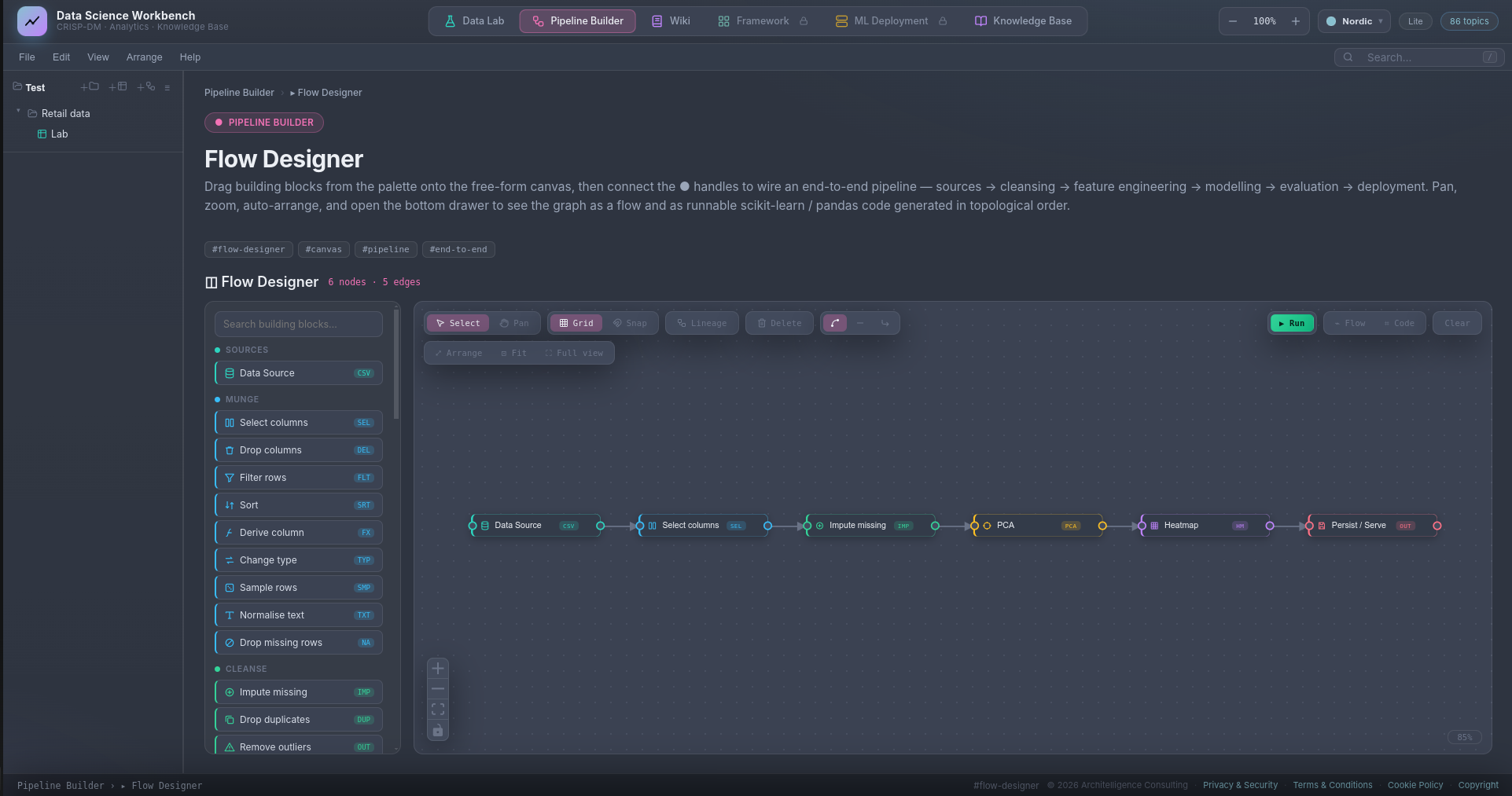
Workspace
The hands-on, engine-backed surfaces.
Data Lab
Import datasets and run real munging, cleansing, analysis and visualisation with pandas & scikit-learn — the hands-on counterpart to the methodology.
Pipeline Builder
A flow designer: drag methodology building blocks onto a canvas, wire an end-to-end pipeline, then generate its flow and runnable code.
ML Deployment
Configure and deploy the MLOps runtime — MLflow tracking server, PostgreSQL backend, artefact storage and a model-serving container.
Integrations
Pull data models, entities and pipeline accelerators from ArchiElementum directly into your analysis workflow.
Wiki
Documentation wiki — folders, markdown pages with live preview and Mermaid diagrams, plus an assembled Body of Knowledge.
Administration
Configure the environment — the Python requirements file with a PyPI version resolver, engine status and appearance.
Analytics & Methodology
The CRISP-DM spine and the four analytics families.
CRISP-DM Methodology
The six-phase, iterative process model that structures every engagement — from framing the business question to deploy & maintain.
Descriptive Analytics
Summarise historical data into interpretable measures and reports — the "what happened" behind every downstream question.
Explorative Analytics
Discover structure, patterns, anomalies and relationships with minimal prior assumptions — the sense-making phase before modelling.
Predictive Analytics
Learn from labelled history to forecast outcomes — regression, classification, ensembles, forecasting and deep learning.
Prescriptive Analytics
Recommend the best action given predictions, objectives and constraints — optimisation, simulation, decision analysis and RL.
Machine Learning
The full toolkit — feature engineering, pipelines and model selection through supervised/unsupervised learning to evaluation and deployment.
Foundations & Reference
Foundations & Reference
The statistical, probabilistic and mathematical machinery underneath the analytics — reference explanations reachable from any method.
Data & ML Blueprints
End-to-end reference architectures — batch training, real-time inference, feature stores, MLOps and RAG.