◆
Featureset
Enterprise Data Architect
Develop a governed enterprise data architecture — principles, policies, capabilities and an interactive model canvas — aligned to DAMA-DMBOK2 and TOGAF 10, with sample artefacts to accelerate delivery.
DAMA-DMBOK2TOGAF 10ArchiMateEA ModellerIndustry Samples
Showcase image placeholder
showcase-data_architect.png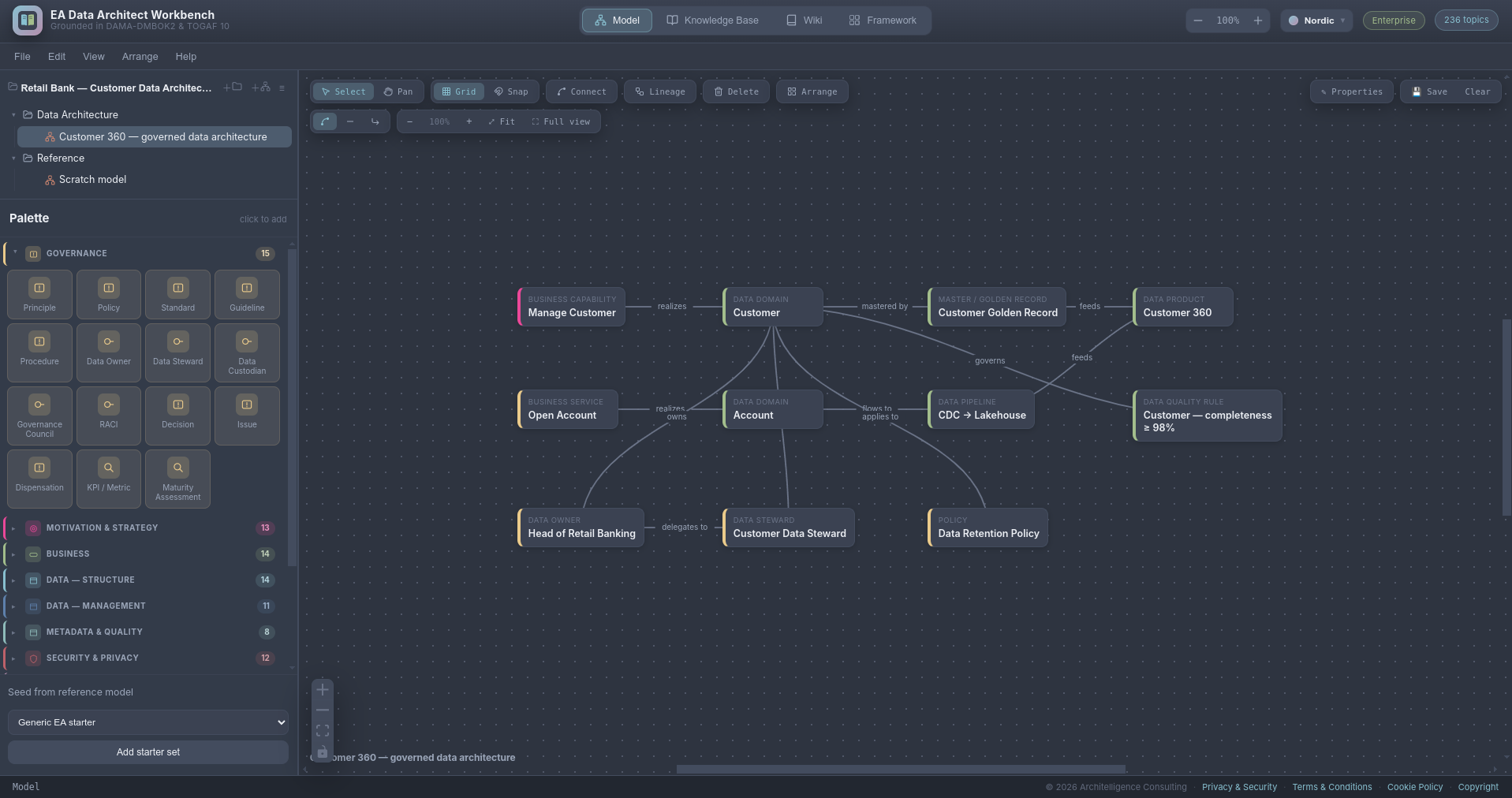
Model & Design
The interactive workspaces.
Model Canvas
An interactive EA / ArchiMate modeller — compose the data & architecture model on a canvas, relate elements and export.
Framework Navigator
Navigate the integrated method and its framework artefacts across the data-management and enterprise-architecture dimensions.
Sources & Integrations
Connect data sources and pull structures into the model; open industry sample projects to start from a worked baseline.
Knowledge Dimensions
The integrated body of knowledge, dimension by dimension.
Data Management Dimension
The DAMA-DMBOK knowledge areas — governance, architecture, modelling, quality, security and the rest.
Enterprise Architecture Dimension
The TOGAF-aligned architecture view and how the data architecture sits within it.
Integrating the Dimensions
How data management and enterprise architecture reinforce each other in one integrated method.
Business Functions
The business-function reference used to anchor capabilities and ownership.
The Lingua Franca
The shared modelling notation and vocabulary used across the workbench.
Agentic AI
Where agentic AI fits the data-architecture practice.
Industry Reference Models & Blueprints
Industry reference models and end-to-end blueprints to accelerate delivery.
Governance Artefacts
Reference/sample artefacts, ready to adapt.
Data Strategy
A data strategy artefact aligned to business goals.
Architecture Principles Catalogue
The principles that constrain and guide the architecture.
Governance Charter & Operating Model
Charter, operating model and the RACI / decision-rights matrix.
Policies, Standards & Procedures
Sample classification policy, naming standard and an onboarding procedure.
Metrics, Risk & Regulatory
Governance metrics scorecard, regulatory requirements register and a data risk assessment.
Enterprise Data Model
Subject areas with conceptual and logical data models and a domain / ownership map.